Showing posts with label Snoopy. Show all posts

Monday, January 22, 2018

Vision, Charlie Brown, and Lucy: "The Highest Form of Cognition"


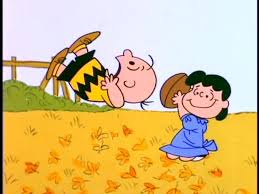
As a sort of coda to my recent posts on Charlie Brown, Lucy, and the football routine, I want to look at reference/homage to it in Tom King's and Gabriel Hernandez Walta's 2016 run of Vision, which has just been released as a hardcover collection. Lots of comics (The BoondocksFoxtrot) and t.v. cartoons (Phineas and Ferb, Steven Universe) have paid homage to the football routine, not to mention the seemingly endless political cartoons that have used it.[1] King and Waltra’s two-page spread in Vision #4, (pages 70-71 in the hardcover), though, succinctly articulates the greatness of the football routine in Peanuts. These two pages of Vision likewise encapsulate the eerie defamiliarization of the “human” that makes Vision such a great comic.

For those who are not familiar with the work, Vision (2016) places the synthezoid member of the Avengers in the suburbs of Washington D.C., where he attempts to build a normal life by creating a wife (Virginia), two children (Viv and Vin), and a dog (Sparky), all the while commuting to work as an advisor to the President of the United States.  Things do not turn out as the Vision hopes. Many people die; the Visions do not access the American Dream. In short, the comic is tragic. It is also brilliant. The Visions do not get what they want. Charlie Brown never kicks the football and the Visions never become human. Instead, they turn the desire to be human on its head.

I have argued in previous blog posts that Charlie Brown does not actually want to kick the football; he values the routine and his complicity with Lucy. In that way, he does not fail to kick the football. He continues to try to kick the football; he succeeds in trying. The same can be said for the Vision. If his family does not succeed in becoming typical Americans, they succeed in trying to live their lives in the way they want to. The scene where Vin and Viv practice trying to kick a football encapsulates this success.

Viv holds the football and Vin runs up to kick it. But Vision does not faithfully follow the Charlie Brown and Lucy routine. Vin becomes both Charlie Brown and Lucy as he tries to kick the football. Viv becomes both Lucy and Charlie Brown as she holds the football. We can see this in the first panel on page 70. Viv, holding the football, paraphrases Charlie Brown’s thoughts about trying to kick the ball. She says, “I will do it again. Reluctantly. But it will have the same result.” To cite just one example among many, Charlie Brown says to Lucy on October 1, 1989, “You say you’ll hold it, but you’ll pull it away, and I’ll kill myself!” Note that while Viv is holding the football as Lucy does, she is outwardly reluctant to continue the routine, as Charlie Brown is. Vin replies to Viv, “Your problem Viv, is that you do not trust.” Vin sounds just like Lucy as he says this, but note he is about to run toward the football, just as Charlie Brown does year after year. Even as the practice a fundamentally human routine (who doesn’t know that Lucy holds the football and convinces Charlie Brown to attempt to kick it?), they get it slightly wrong. There is something off about it. Vin is both Charlie Brown and Lucy. Viv is both Lucy and Charlie Brown. It is in this offness, though, that Vin and Viv show that they have a more-than-human knowledge of the Charlie Brown-Lucy football routine. Both Charlie Brown and Lucy are necessary for the routine. They both must have a desire for Charlie Brown to attempt the kick. They both must have a desire for him to miss the football. They both must have a desire for the routine to continue.

As Vin and Viv continue, Viv says, “This is the seventh time I am preparing this game, Vin. The ball has not moved. You have not kicked it. You have not earned my trust.” Charlie Brown and Lucy performed the football routine 43 times in nearly 50 years; Vin and Viv might be trying to replicate those attempts in one afternoon. As he runs toward the football, with Charlie Brown-like posture, Vin speaks more words that sound like a synthezoid Lucy. “Trust is the ability to believe without evidence. It is an act of faith. The highest form of cognition.” The next panel shows a close-up of the football, held in place by Viv’s finger. Vin continues. “Understanding and embracing faith moves us closer to humanity.” This definition of “faith” fits both Vision and Peanuts. It is not religious belief that constitutes the basis of faith. God is not necessary for faith. Faith can be any unearned act of trust. Lucy has not earned Charlie Brown’s trust, but she does have his faith. The Visions are not trusted by any members of their community. They do not even have a rational belief that their lives will turn out well. But they do have faith. They continue. They act in ways that show their faith, absent of any trust. They go to school. They receive cookies from the neighbors, but since they do not eat, they throw the cookies in the trash after the neighbors leave. They do not trust in humanity—their own or anyone else’s—but they do have faith in their approach to humanity. They will keep running toward it.

As Vin reaches the football, Viv does not pull it away. Instead, Vin “phases” through it. As a synthezoid, he can change the space between his molecules so that his foot passes through the football, which never moves. In essence, he pulls the football away from himself. Viv asks, “Why do you keep phasing?” and Vin replies with a Lucy-like laugh, “Hahahahahaha.” He continues to laugh as Viv throws the football at him, which phases through his head. She says “It is not funny. . . .It is sad.” Things then degenerate into a semantic argument. Vin tells Viv that she is “sad” because she believed him. She replies “I am not sad. I am discontented.” At this point they are interrupted by their father. Vision contains many passages about the meanings and connotations of American human language, such as Vision’s and Virginia’s discussion over whether it is better to say, of friendly neighbors, “They seemed kind,” or “They seemed nice” in issue one.

It is also Vision who sets up the the questions of truth, faith, and humanity that Vin and Viv try to work out in their version of the football routine. When Virginia reaches the conclusion that the phrase “They are nice” is both the correct phrase and a meaningless phrase, Vision says, “To assert a truth that which has no meaning is the core mission of humanity.”( I wonder if he says “that which” because he does not fully understand the grammatical rules for the uses of “that” and “which” and thus uses both.) He then makes contrasting statements, articulating first the evil vision of his creator, Ultron, and then of his own vision.  “The pursuit of a set purpose by logical means is the way of tyranny; this is the vision of my creator. Of Ultron.” “The pursuit of an unobtainable purpose by absurd means is the way of freedom; this is my vision of the future. Of our future.” Tyranny flows in a straight line through logic. Freedom winds through the unobtainable and the absurd. The Visions are free. Charlie Brown and Lucy are free.

And the Visions dog is named Sparky, which is, of course, the nickname of Charles Schulz. (I do not mean to claim that any of these similarities are intentional, as, for example, Sparky’s name came from a reader’s contest in the letters page of Vision.) In at least one sketch, though, Sparky bears some resemblance to Snoopy.


[1] See http://peanuts.wikia.com/wiki/Football_gag for a list of other references


Wednesday, January 17, 2018

Lucy, Charlie Brown, Football: Part 10: 1995-1998


1995-1998: Thermodynamics


39. October 29, 1995
1995 starts out in traditional form. Lucy call out "Charlie Brownnn . . ." He responds "Again?" and Lucy makes the same proposition. Like he as often done, Charlie Brown exclaims about what will happen when Lucy pulls the ball away. "I fly through the air, and land on my back, and kill myself . . . That's what happens!" Lucy's rationalization in the next panel has unintended consequences. She says "You could always sue . . ." As Charlie Brown walks away from the football in the second to last panel, he says "If she pulls the ball away, I'll sue!" He has not even turned around to run toward the football yet and we only have one panel left. In the final panel, Charlie Brown runs silently toward the football. He seems to be running slowly. He does not look particularly intent. There are no lines behind him signifying speed. In fact, running close at his heels is the World Famous Attorney (Snoopy in a bowtie and bowler hat, carrying a briefcase). Charlie Brown has lawyered up! The World Famous Attorney, of course, loses all of his cases. We never see Charlie Brown attempt to kick the football in 1995. Unlike previous years, when we did not see the attempted kick but were able to hear it, this year the strip stops in the middle of Charlie Brown's run toward the ball. How will Lucy react to the Attorney's presence? Will she be sued? We will not be told. When Josef K., after his arrest,  talks to the painter who has spent much time around lawyers, K is told that three forms of acquittal are possible: "Absolute acquittal, apparent acquittal, and deferment" (182). K is quickly told that "absolute acquittal" is impossible. "Apparent acquittal" is described as a convoluted legal process that offers little chance of actual acquittal. "Deferment," then seems the best option. In a deferred judgment, the trial is kept open but it never passes its initial stages. Preliminary interviews take place, but the trial never proceeds. As the painter says, "the trial's been artificially constrained inside a tiny circle, and it has to be continuously spun round within it" (192). Josef K. chooses this option, and so does Charlie Brown. From year to year, his straight lines toward the ball become a circle. He kicks; he misses; he kicks again; he misses again. By this point readers do not even need to see the attempt to know that it is always taking place.


40. October 20, 1996

Once again, we start with the giant football. This time Lucy and Charlie Brown appear to be lying asleep on opposite sides of the football. Are they finally becoming exhausted with this routine? Do they just want to rest? Panel two shows Charlie Brown looking to the left. Hand held over his heart, he says, simply, "Me?" We can finally see that Charlie Brown is playing a role just as much as Lucy is. Of course it is you Charlie Brown. Who else could it be? Lucy offers the usual proposition and Charlie Brown responds with the same indignation. To convince Charlie Brown that things might be different this year, Lucy returns to one of Charlie Brown's old themes: symbolism. In 1982, Charlie Brown goes on and on about the symbolism of the routine. He wonders if he has "missed the symbolism." This year, Lucy returns to that theme. "Symbolism, Charlie Brown! The ball! The desire! The triumph! It's all there!" Charlie Brown of course falls for this challenge. He repeats part of what Lucy says and adds "She may be right . . " as he walks away from the football. As he runs toward the football he says "The ball? The desire! I see it!" Charlie Brown feels like he has finally found meaning in the routine at this late date. He quickly sees his error. "Aaugh!" "Wump!" He is on the ground. Lucy has not smiled during this whole routine. In 1982, her reply to Charlie Brown's wondering if he missed the symbolism of the event was a purely literal statement "You also missed the ball, Charlie Brown." It has taken fourteen years, but Lucy finally closes the hermeneutic circle around Charlie Brown's neck. "No, you missed the symbolism, Charlie Brown" First, in 1982 he missed the ball; now he misses the symbolism and the ball. He asks, dizzy and propped on his elbows, "How about the reality?" You, Lucy, and the football are the only reality.

41. September 21, 1997
There are only three football routine comics left. This one starts in the traditional way. Lucy call Charlie Brown. As he walks toward her, he asks "Why me?" He answers his own question, "Because I'm stupid, that's why!" Lucy makes the usual proposition. Charlie Brown looks especially glum, in the fourth panel, as he states what will inevitably happen. His eyes are drawn close together and his mouth is a tight frown. Lucy offers him some hope. "Not necessarily . . . people change . . Times change . . . You can feel it in the air . ." Charlie Brown is convinced. He agrees with Lucy. "I think she may be right . . . I've noticed the same feeling . . " he says, as he walks away from the football. He runs toward the football with confidence, intent to "kick that ball clear over the border!" Are times changing because the football routine is reaching its end? Has Lucy's nostalgia and depression of the last few years led her to rethink pulling the football away? Will Lucy give in to sentimentalism? Not this year. "Aaugh!" She pulls the ball away and Charlie Brown flies through the air. But Lucy has done something different! As she pulls the football away, she turns her head and shouts out "Where? Where ?!" Charlie Brown lands with a "Whump!" The final panel shows Charlie Brown sitting up, a curling line and three stars floating around his dizzy head. Does his sitting up signify that more time has passed than usual? Has he recovered enough that he no longer needs to lie down? As he sits, Lucy kneels next to him and says "Sorry Charlie Brown . . . I thought I heard someone say the millennium is coming . . ." Yes, Lucy has made a Y2K joke, and nearly three years early. She clearly had this one planned out. It is worth noting that this is one of the few times that Peanuts makes reference to a specific year, even as there is nothing specifically millennial about this particular strip.


42. November 15, 1998
This is the penultimate football routine strip. The first panel gives the the final appearance of the giant football. Charlie Brown reclines, his head resting against the bottom of the football. Lucy peers around the top of the football. Is she floating? Is she holding onto the football? All we can see is her head. In panel two, a kneeling Lucy calls out "Over here!" She makes the proposition. Charlie Brown has a new response "I can do that . . ." Lucy looks slightly surprised in the next panel where we see a close up of their faces. "You can?" she asks. "Absolutely! I have a new positive attitude!" Charle Brown answers. Does he truly believe he can kick the football? Or is he trying to outsmart Lucy? Does Charlie Brown believe that his baseball team will win a game? Does he believe that he can fly a kite and avoid he kite-eating tree? Does he believe he will get a Valentine? As Charlie Brown walks away from the football, Lucy says "I can't believe it . . You are truly amazing! You talk the talk and you walk the walk!" Charlie Brown runs silently toward the football. "Aaugh!"Lucy pulls the football away but her face shows little emotion. She is neither smiling nor frowning. She is simply doing what she has to do. In the final panel, she stands over Charlie Brown, who is propped up on his elbows, and says "But you don't kick the kick . . ." Lucy has finally stated the fundamental truth of the football routine.  Charlie Brown will never kick a football held by Lucy. His best chance was in 1979, but he missed. His missing the football is a basic physical truth, like the "Wump!" of gravity made by his falling body. This year's strip omits Charlie Brown's landing. We know it is there, though, just like we know that energy is neither created nor destroyed, only transferred from one form to another, but never from Charlie Brown's foot to the football.


A Report From Nancy Fest

      A Report From Nancy Fest   We (my son and I) arrived at Nancy Fest at around 7:30 on Friday, May 24 so we missed most of the welcome t...