Showing posts with label Ernie Bushmiller. Show all posts

Monday, June 3, 2024

A Report From Nancy Fest


A Report From Nancy Fest


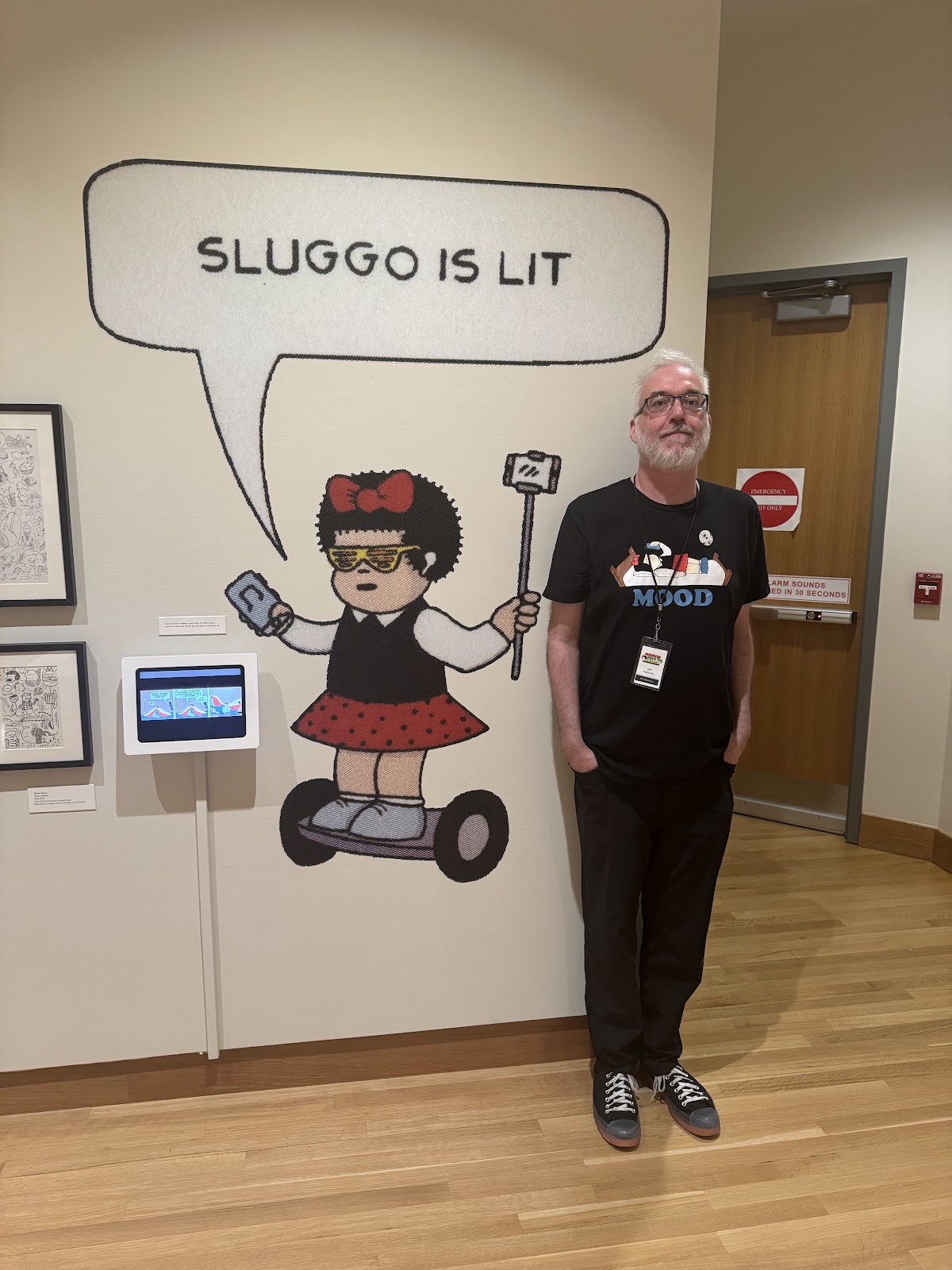
We (my son and I) arrived at Nancy Fest at around 7:30 on Friday, May 24 so we missed most of the welcome talk. We drove the 650 miles from Des Moines to Columbus through torrential storms in Illinois and I forgot that we were driving from the central time zone to the eastern time zone. We should have left earlier. Anyway, we arrived hungry and were happy to find vegan hot dogs at the reception. We checked out the exhibit and talked to some people. The first person I talked to happened to be the guy who goes by “Erniebushmillerjrjr” on Instagram. We chatted with Bill Griffith, not realizing that he had been talking with Chris Ware!. There were more Nancy and Sluggo t-shirts here than I’ve ever seen anywhere else. 


On Saturday morning, we showed up at 9 for donuts and coffee. The first panel of the day “The Nancy Summit, oyr, The First Official Meeting of the Ernie Bushmiller Society” convened at 10. Brian Walker, Dennis Kitchen, Gary Hallgren, Kaz, and Bill Griffith (Patrick McDonnell had to cancel) discussed how and why they first came to appreciate Nancy and Bushmiller. I was not taking notes so I don’t remember exactly what everyone said (I know, great report) but one moment stood out for me. During the Q&A session, a member of the audience asked the panel what they thought of Olivia Jaimes’s Nancy. I was expecting to hear some disdain at this point, but that didn’t happen. A few panelists said they didn’t really follow Jaimes’s strip that much, but they were glad that the strip was popular. Brian Walker, who curated the exhibit, then said that he read a book called The New Nancy by some professor whose name he couldn’t remember. That professor was me. Walker said the book led him to appreciate what Olivia Jaimes was doing in the space between newspaper comics and webcomics. I was thrilled that he had read my book. 


At 11:30, the next presentation, and the one I was most excited for, started. The panel was called simply “The New Nancy.” Olivia Jaimes had planned to attend Nancy Fest in person, but could not. She recorded a slide presentation and asked that it not be recorded by the audience and that it be deleted right after her talk. Even as the voice reading the presentation spoke in the first person as Jaimes, I believe it was actually Jaimes’s editor, Sheena Wolf, who was reading.  Regardless, Jaimes presentation “How to Write Nancy” showed that she has studied Nancy in depth. 


Jaimes’ presentation used the humor that she brings to Nancy. She began by noting that what was to follow was “simply my take” and then saying “I am totally right about everything.” Jaimes argued that “a very specific type of gag defines Nancy.” Using a Bushmiller strip where Nancy looks at a crooked picture hanging on the wall and, instead of straightening the picture, she makes the chair she is sitting in crooked, Jaimes said that one could remove Nancy, Bushmiller’s draftmanship, and even change the words of the strip and it would still be recognizable as a Nancy gag. For Jaimes, a Nancy gag is a kind of analogy that makes “a nice shape” so that “Crooked frame is to straight viewer as straight frame is to crooked viewer.”  Jaimes went on to give multiple examples of these shapes in Nancy comics. She began to wrap up by saying “I love her.  I love Nancy so much.” Jaimes concluded by saying that she is “talking a brief and mysterious break” and that guest strips of Nancy would start appearing at the end of June. 


After a lunch break, Mark Newgarden and Paul Karasik spoke on their foundational book How to Read Nancy. I’m sure most people reading this are familiar with their book so I won’t recap their discussion. I will note that their talk made clear just how much work they put into gathering the materials for their book, finding original copies of strips, and painstakingly working on the book’s appearance. They also noted that they thought they were finished writing about Nancy but wrote a short essay for the exhibit catalog about Nancy’s face. 


The next speaker was Bill Griffith, talking about and reading from his graphic biography of Bushmiller, Three Rocks.  His talk was fascinating. Griffith said that he hears his creation Zippy the Pinhead’s voice as somewhere between Raymond Burr and Julia Child. I had never thought about what Zippy sounded like, so this information has changed the way I read Zippy. Among other insights, Griffith argued that Fritzi’s and Nancy’s relationship was antagonistic and that Bushmiller had wished he could drop Fritzi from the strip, as he had inherited her character from Larry Whitington. Griffith talked about rejecting the idea of there being a firm line  between art and comics, which I’m sure his audience wholeheartedly agreed with. He talked about some similarities between Edward Hopper’s work and Nancy. He talked about the strangeness of 8-year old Sluggo’s libido. (It’s worth noting that Jaimes’s reboot of Nancy did away with any idea of a romantic relationship between Nancy and Sluggo, as well as leaving behind Sluggo’s attraction to every pretty girl he sees.) Griffith briefly talked about Olivia Jaimes. He said that Jaimes has not captured  the surrealism of Bushmiller’s work. He also said that Jaimes seems not to be concerned with craft. I think he’s completely right about both of these things. I think that Jaimes has used concerns about craft as content of her strip. Her “bad” art often serves as the gag in Nancy. See, for instance, her December 22, 2018 and March 5, 2019 strips.
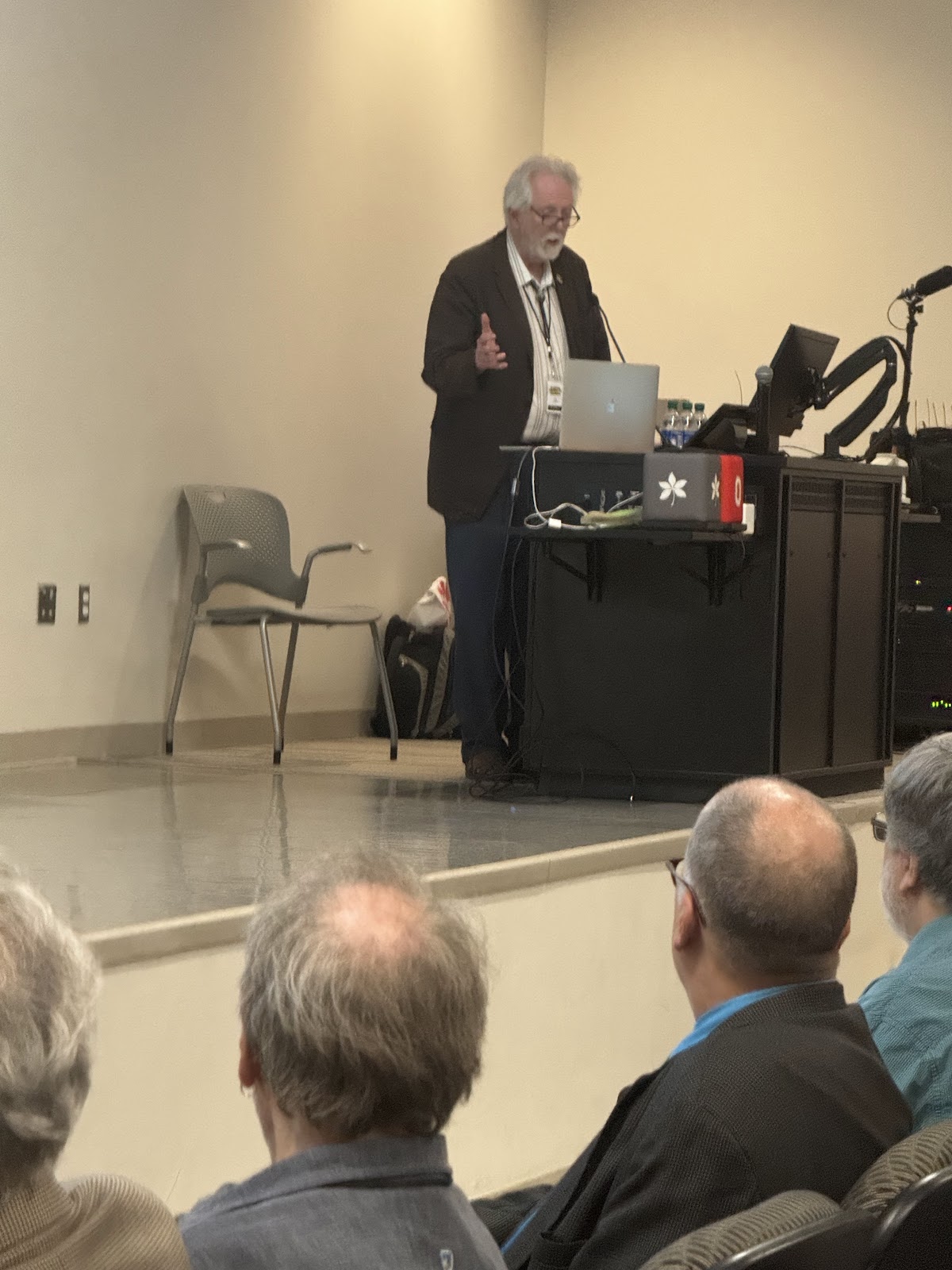


But getting back to Griffith’s presentation, he read the epilogue to Three Rocks, in which his comic alter ego “Griffy” meets up with an aged Nancy at the “United Features Retirement Facility No. 34” which is situated behind the “Bushmiller Museum of Comic Art” in Stamford, Connecticut.  The epilogue is my favorite part of Three Rocks.  Readers see that Nancy characters Plato, Spike, and Dagmar all live in the retirement village. Sluggo, however, does not. Nancy thinks to herself “I dream about him all the time.” Sluggo meets up with Griffy and decides to go talk to Nancy. Sluggo has a long white beard and moustache. They play bingo and reconcile. I don’t think many people would say that Nancy is emotionally poignant, but Griffith’s epilogue certainly is. It was a joy to hear him read it and comment on it. 


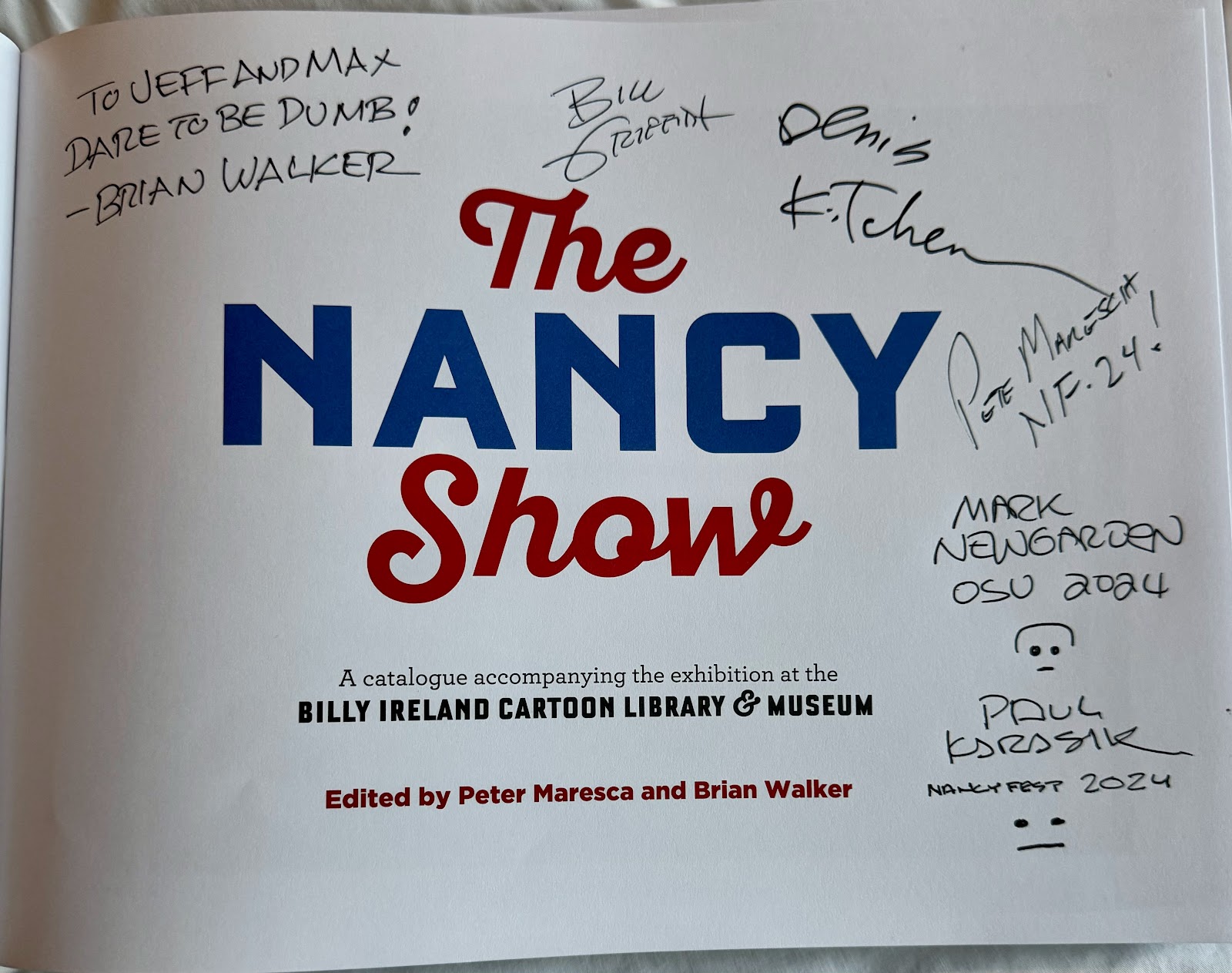
At the book signing, I got Bill Griffith, Paul Karasik, Mark Newgarden, Denis Kitchen, Pete Maresca and Brian Walker all to sign my copy of the Sunday Press catalogue for The Nancy Show: Bushmiller and Beyond. Brian Walker was sitting next to Bill Griffith. I thanked Brian for reading my book, and I’m somewhat embarrassed to say,  I gave a copy of The New Nancy to Griffith. He at least pretended to be interested in it. While waiting in line at the signing, I talked to Gary Hallgren, who was selling original art. I had not known that he was now the artist for the comic strip Hagar the Horrible. I then realized that this fact answered a question that I had been wondering about for over a year. On May 5, 2023, Helga is sitting at a table with a woman who looks like what an adult version of Nancy drawn in the Hagar comic style would look like. Hallgren put her in the comic pretty much because he could. 


We unfortunately missed Tom Gammil’s play A Morning with Ernie Bushmiller as my son wanted sushi for dinner. I stopped briefly by the afterparty but did not stay long as I was tired. We drove home on Sunday. 


Nancy Fest was incredibly well done. Brian Walker’s curation of the exhibit is stellar.  Caitlin McGurk and the staff at Billy Ireland Cartoon Museum did a brilliant job. It was well worth driving over a thousand miles round trip in three days. Nancy Fest is over but the exhibit is at the museum until November. If you haven’t seen it, you should go. And you should buy a copy of The Nancy Show: Bushmiller and Beyond and, if you don't already own them, How to Read Nancy and Three Rocks


Monday, November 25, 2019

Re-presenting Poochie

Re-presenting Poochie

 I’m back writing about Nancy, hopefully on a more regular basis.
Readers of Nancy will know that Olivia Jaimes does not use many Ernie Bushmiller legacy characters besides the obvious big three of Nancy, Sluggo, and Aunt Fritzi.  Peewee, a toddler who Nancy sometimes babysat, is now a small child who takes things way too literally. When he is told that a basketball game is going to be “a walk in the park,” (July 10, 2019) readers see him in the final panel strolling through a park “miles away.”


But we haven’t seen any of Bushmiller’s adults such as Phil Fumble, Mr. Sputter and his wife, or Professor Floogle. Likewise the neighborhood kids Spike, Knuckles Noonan, Rollo the Rich kid, Nosy Rosie, Irma, Janie, and many others remain in the past. Nancy’s pet monkey, pig, sheep, and cat have not come back, and until recently her dog Poochie has only appeared once, briefly and unnamed, on June 27, 2018.


But, finally, during the last week of September, Poochie became the focus of five daily strips in a row.  As if reminding herself, her readers, and the characters in the strip that Nancy has a pet dog, Jaimes starts the week with a visual joke about Poochie’s existence. Her teacher, unaware that Nancy has a dog, asks her about it. Nancy then mentions Poochie by name for the first time in Jaimes’ strip, and then describes her. Nancy then implies that Poochie has been present by asking her teacher, “You’ve never noticed Poochie!?!” The punctuation “!?!” shows that Nancy is confused at her teacher’s lack of observational skills. Jaimes then has Nancy make a meta- joke by saying that Poochie is just a bit too short to appear in the comic. 


 There’s more than meets the eye going on with this joke. Comics scholar Katherine Kelp-Stebbins, in her essay “Reading Spaces: The Politics of Page Layout” has noted that comics “may be representations of space and spaces of representation simultaneously.”  Poochie’s invisibility exemplifies this point.  The rectangular panels of Nancy can be considered as “representations of space” in two ways. First, each panel delineates an exact space—panel one in the above strip represents the space that holds Nancy and her desk, a small section of the floor, a part of the wall, and a small bit of window. The third and fourth panels draw a rectangle around a smaller space—two thirds of Nancy’s desktop, her upper body, and part of the wall behind her. Second, readers of the comic read the strip as a whole and understand that the four strips together represent a classroom. Even if we only see Nancy at her desk in three panels and her teacher’s upper body in one panel, along with the aforementioned floor, wall, and window, we “see” that these four fragments represent a larger classroom that contains more desks, students, floor, walls, and window. We tend to do this seemingly without thought; we know Nancy and her teacher are in a classroom even as most of the classroom remains invisible to us.


Likewise, this strip can be seen as a “space of representation” in two ways. First, readers, and this writer, have to bring a lot of assumptions to the act of reading to see a classroom in this strip. Most readers will have their own experience of an elementary school classroom, of desks, and teachers, and floors, walls, and windows. As Kelp-Stebbins writes, readers and creators “activate and mobilize these technical possibilities into emergent forms of expression and meaning.” That is, our familiarity with these objects and this spatial arrangement is something we take for granted—we think the elements of the strip mean “classroom,” and we might take this representation of a classroom as a universal one. After a bit of thought, such taken-for-grantedness reveals itself as false. Not every child has access to a learning space like Nancy’s. Being able to understand what a space means is always political; that’s how I take what Kelp-Stebbins writes. Yikes! I’m now pretty far away from thinking about what’s funny about Jaimes’ joke. The second way I want to take “space of representation” gets closer to the joke. The panel can be seen as a space of representation in a very literal way in that it marks out what is actually drawn and thus represented to readers. In this way, the panel is like frame. We can see everything inside the frame precisely because Jaimes determines the perspective and scale of the frame. We see what she wants us to see. If she had wanted, she could have framed a panel so that readers could see multiple desks and students or even the entire classroom (minus the fourth wall, of course, that would make the room impossible to see). The perspective of panel four just happens to be “exactly” as low as Poochie is tall so we cannot see her, even if she is there. Nancy explains Poochie’s seeming absence from the all other strips (with that one earlier exception) when she universalizes her claim. Poochie is not just the exact right height not to fit in the panel in question, she is too short for “the bottom edge of every panel.” Poochie may have been in every single Nancy up to now and we would never have known because we could not see her. She does not seem to be in this particular strip though, as the first panel shows us the space below the bottom edge of panel four. Unless Poochie is below the floor we can see in panel one, she is not in this strip.  As a subtle final touch to this joke, Jaimes draws Nancy’s hand in the fourth panel so that a part of her thumb covers over the line that marks the bottom edge of the panel, and marks the tiny space between the bottom line and the top of Poochie. 

This joke seems to set Poochie free. The next day, she makes her way into all four panels. 


Notably, this strip is wordless and uses old-style visual cues to tell readers what is happening. Panel one sets up that Nancy wants Poochie to jump through a hoop, with a biscuit as a reward. The next three panels show us that Poochie has other thoughts, as represented by an “X” that marks a starting point for where Poochie is and dotted lines signifying the route that Poochie walks (or runs) to reach the treat without jumping through a hoop. Poochie cannot talk and we are given no words, but we know how she thinks. While this strip is not drawn from Poochie’s point of view, it does give us Poochie’s perspective on tricks and biscuits. As the next day’s strip illustrates, Poochie has become a means to think and joke about perspective and representation.
 
On September 25, we first see Poochie in the second panel, framed within the portrait view of Nancy’s camera. We have a representation of a representation, as Poochie appears within two frames, when she previously was outside of all frames. Nancy becomes distracted by the third frame in panel two, a television showing Pikachu. If Poochie won’t entertain Nancy and help her to become famous, Nancy will just watch t.v., filtered through her phone screen. 

The next day, Nancy, is outside eating a dripping ice cream cone while saying that she doesn’t get into trouble because she only spills food on the “black polka dots” of her pants (even though the ice cream cone looks brown?). Her upper body fills about two thirds of the panel and the speech bubble above her head fills the rest of the panel. Agnes, in panel two, framed pretty much the same way, asks her what happens if she’s standing up and eating. 


The joke of panel three at first seems to be that, when standing, Nancy only spills food on Poochie’s black spot. But the funnier joke takes us back to panel four of September 23. As Poochie is revealed in the third panel, we can retroactively see her below the panels of frame one and two, exactly where she would be if we think about how each panel represents space. 

The next day, Poochie does not appear in the first two panels, and Nancy does not even refer to her by name, only as “my dog."There’s a joke about acorns, and training, and squirrels as Esther questions Nancy. Both Nancy and Esther are shown from the waist up in panel one; Nancy is shown from the shoulders up in panel two. I cannot concentrate on what they are saying because I am wondering what Poochie is doing below the bottom panel. Panel three uses depth to show a squirrel in the foreground contemplating running the obstacle course that Nancy has created for it. But that is just and excuse to place Nancy and Esther far back in the landscape. We see their whole bodies standing on the horizon between ground and sky. They look tiny to signify that they are far away. Their height is only about 1/9th of the panel’s height; they are drawn just about the same size as the squirrel in the foreground. And who is sitting there next to Nancy, drawn reaching up to Nancy’s midsection: Poochie, who has been in that exact spot the whole time. The perspective joke is funnier than the squirrel joke. Poochie returns to the strip  a few times in October but I wonder if she ever leaves. 


Sunday, January 20, 2019


Is this the best Nancy strip ever? 


Olivia Jaimes has written what is perhaps the greatest Nancy comic ever, and it is published on January 20, 2019. 

The comic uses a regular trope of the Bushmiller years in which Nancy reaches for a cookie jar and is caught be Aunt Fritzi.


In the foreground of panel one, we have a refrigerator with a cookie jar on top. Nancy peers from the kitchen into the living room, where Aunt Fritzi sits on the couch reading the newspaper. We see Nancy from behind and from mid-torso up. We do not see her eyes, but based on her head position, we can see that she is looking into the living room to see if Aunt Fritzi is watching her. Jaimes has set up the joke, a joke that was an Ernie Bushmiller staple (and more broadly, a comic staple): Nancy will come up with an ingenious scheme to reach the cookie jar. Aunt Fritzi will discover Nancy with her hand in the cookie jar. Nancy will be punished. 

Panel two supplies the means for Nancy. A ladder appears on the right side of the panel and Nancy is nowhere to be seen. Look at the geometry of this panel. The left third of the panel gives us the rectangle of the refrigerator. The center third gives us another rectangle, the doorway between kitchen and living room, through which we can see Aunt Fritzi on the couch. The truncated triangle of the ladder takes up the right third of the panel, with the ladders supports dividing the triangle into three four-sided shapes. The panel is crowded. We only see the top two-thirds of the refrigerator and of the ladder. We can see the living room floor but not the kitchen floor. A foreshortened oval cookie jar sits atop the refrigerator. Jaimes has left more open space in the top of the panel than one might expect. Note, too, that the refrigerator and the ladder butt up against the left and right frame of the panel. We do not see the back of the refrigerator and we see less of the right side of the ladder than of the left. And Jaimes has set up a spacial problem. The ladder is too far away from the refrigerator to aid Nancy in reaching the cookie jar. 

Nancy takes advantage of the open space at the top in panel three. We see the same view in panel three: refrigerator with cookie jar, doorway framing Fritzi, and ladder. But now, Nancy stands atop the ladder in profile. Her upper body, her arms, and her head cross into the gutter (the white space between panels) and part of her face extends into the next panel. Nancy breaks the barrier of panel three, of the gutter between panel three and four, and panel four. In the process, she changes our understanding of how the panels relate to one another. We unthinkingly assume that each panel of the comic has been giving us the same point of view of the kitchen over a series of sequential movements. But now we see that Nancy, standing in the extreme right of panel three is also standing to the left of panel four. She is behind the refrigerator. The implied (but undrawn) wall behind the refrigerator (whose refrigerator is not against a wall?) does not exist. Nancy reaches into the left side of panel four with her hands. We see the result of this action in panel four. Two motion lines show us that she has used the ladder to reach the cookie jar and to throw it from its heretofore unreachable perch atop the refrigerator. The cookie jar flies through the air in the top of the panel. A small part of the cookie jar even crosses into the gutter at the top of panel four. Importantly, the jar flies above the doorway so that Aunt Fritzi cannot see what Nancy is doing. But who will catch the thrown cookie jar? 

Nancy will, of course, in panel four. But stay with Nancy in panel three for a moment. Notice that she has anchored herself with her left leg along and the right edge of panel three. She leans so far on top of the ladder that she should fall. Most of her left foot and part of her left leg, though, is obscured by the panel line and the gutter. It’s a three-dimensional joke in a two-dimensional space. The way her skirt and upper-body exist in the foreground—both in panel three and in front of it (as she crosses the gutter) makes it impossible for her left leg to be leaning against the panel line, which would be behind her if the space were three-dimensional. In two dimensions this is not a problem. She can lean against the panel line to support part of her body while another part of her body crosses through another part of the panel line and through the gutter and through the left panel wall of panel four (not to mention the implied wall that the refrigerator should be up against). 

The use of space becomes even funnier as a reader realizes that, even as the panel lines and gutters have become a physical part of Nancy’s world (they exist within her two-dimensional frame of reference or she wouldn’t be able to move across/through them), the gutter still serves its traditional purpose of denoting the passage of time between panels. Even as we see the cookie jar in a moment of frozen flight in panel four, we realize that the Nancy at the top of the ladder in panel four, drawn in profie, slightly crouched, with arms out, in anticipation of catching the jar, has turned 180 degrees between panel three and four. And she has turned fast, within the time it takes Nancy in panel three to throw the jar nearly half way across panel three, otherwise the jar would hit panel four Nancy in the back of the head. Jaimes does not illustrate Nancy’s movement. Unlike the motion lines that show the movement of the cookie jar, Nancy of panel four is simply facing in the opposite direction as Nancy of panel three. For the comic to make sense, we just have to know that she has quickly pivoted atop the ladder in the elapsed time of the gutter (which remains an actual physical space at the same time). 

Panel five shows us Nancy sitting atop the ladder, her hand inside the cookie jar, content in the knowledge that Aunt Fritzi has not looked up from the newspaper through the first five panels, and has thus not seen Nancy’s trick. Panel six shows us Nancy with a cookie with a bite taken out of it in hand. She thinks she has gotten away with her cookie thievery. She does not seem to notice that Aunt Fritzi has arisen from the couch and is walking toward the kitchen, with the newspaper under her arm. 

While I first thought that the comic’s gag was in the breaking of the wall between the third and fourth panel, the joke reaches another level in panel seven. Nancy is caught, as Aunt Fritzi, now in the kitchen, stares up angrily at Nancy. Nancy says, “But I broke the fourth wall! How could you see me?” At this point, it seems like Nancy’s awareness that she’s in a comic strip—“I broke the fourth wall)—is what Bushmiller called the snapper, the moment the joke hits home. But then we have the final panel, panel eight.

Panel eight closes in on Fritzi’s face. She hold up the newspaper in her left hand and point to it with her right. She has been readingNancy, which allowed her to see what Nancy was up to in panels one through eight. The final panel, partially obscured by Nancy’s hair (and note how we cannot see Nancy’s face in this panel, just as we cannot in panel one), shows us the face of a tiny Aunt Fritzi pointing at a newspaper. We cannot see the newspaper inside the comic, which also would show us Nancy’s face looking at the comic page into infinity. Aunt Fritzi does not have to say a word. She is like Destiny from The Sandmancomics; she can read what has happened, what is happening and what will happen, but she does not have to say anything. 

And there’s still more. Nancy, as it appears on the GoComics website, contains eight panels. The Nancythat appears in the newspaper in panel eight is made up of nine panels. There’s an extra panel in the newspaper. Looking closely, panels one and two of the online comic correspond to the first three panels the newspaper comic. Panels three through eight of the the web comic correspond to panels four through nine of the newspaper comic. Panel three of the newspaper comic, which is partially obscured by Nancy’s head in panel eight of the web comic, does not appear in the web comic. It seems to exist in the space between panel two and panel three of the web comic. In terms of time, the newspaper panel seems to take place during the time in which Nancy actually climbs the ladder, which we are never shown, because we don’t need to see it. If you look closely at panel three of the newspaper comic (in panel eight of the web comic), you can see the refrigerator, the cookie jar and part of the doorway, but Nancy’s hair blocks our view of the ladder, so that we can see her climbing in neither the web comic nor the newspaper comic. And for a final snap, I bet more people read today’s Nancyonline, not in newspapers. 


Friday, May 4, 2018

This Week in Nancy: "Mass Hysteria"

In How to Read Nancy, Karasik and Newgarden, in their discussion of "ballon design," note "Any number of word balloons can be used within a panel . . . For Bushmiller one balloon per panel was the norm, two were the exception, and three or more were reserved for mass hysteria" (140). On April 28, then Olivia Jaimes gives us mass hysteria. Five word balloons crowd the space of the third panel, crushing Nancy, who pulls her arms toward her body and grimaces. All of the words in the balloon exceed the space of the panel; almost half of the words cannot be read because the push into the invisible space inside or underneath the panel.


The words themselves continue Jaimes' meta-commentary from last week about Ernie Bushmiller purists. The first panel features Nancy, seemingly floating in white space, while someone off-panel intones, "Nancy is iconic for her simplicity." In panel two, another voice adds a longer commentary--notice that the line of the word balloon is lower in the second panel than the one in the first, suggesting a second speaker. Another speaker than chimes in from the right. We cannot see all the words that this speaker intones. The words will not fit in the panel. And the word balloons are beginning to crowd Nancy. She raises her hand as if defense, as if she is getting ready to push back. Her half-smile from the first panel becomes a frown. Her eyebrows straighten out and push toward each other. By the third panel, her mouth opens slightly in a frown. She looks like she cannot breathe. Word bubbles from the left and from the right touch each of her hands as she tries to push back. The word bubble in the bottom right side of the panel cover part of her shoe. Nancy is in danger of being blocked out, erased. That's the gag. The online commentary is not allowing us to see Nancy today.


On Monday, April 30, Jaimes continues her meta-commentary. Speaking to Sluggo, Nancy says "I'm sick of these reboots and restarts." Fans of Bushmiller everywhere nod in agreement (perhaps while they acknowledge but dismiss the irony as simplistic). Panel two zooms in on Nancy's angry face, ash she complains "why can't something that's gone stay gone?" The half of Sluggo's face that we can see looks neutral--his mouth a straight line, his nose a quarter circle and a dot, his pupil a black dot, and his eyebrow a semi-circle above his eye. Panel three pulls back from Nancy's face. We see four bushes and two gigantic flowers. Tiny black dots of pollen emanate from two of the bushes and the flowers. There are no rocks. The gag, as revealed by Sluggo's dialogue: Nancy was talking about the return of spring, and the pollen that causes her allergies. See--she wasn't talking about her own reboot. We have one more day of direct meta-commentary ahead of us. 

On May 1, Nancy sits on an undersized chair and looks through her window at the black diagonal slashes of rain falling. She says "I love the sound of rain." Readers, of course, cannot hear the rain, we can only see the black lines that signify rain is falling. In panel two, which zooms out a bit, Jaimes helps us to hear the rain. The word "PLOP" appears seven times, in bold type, around the window. But Nancy sees the words! The gag is in panel two. Her word balloon partially covers two of the "PLOPS" as she says "also the sight of the sound of rain." Karasik and Newgarden write, "In short: the lettering in comics is generally meant to be read and not seen." Undermining that general knowledge establishes the gag--we first read the words and hear them as the sound of rain but then Nancy sees them and we cannot help but see them. She concludes, in the third panel, her face occupying the middle third of the panel "Ahhhh . . . so relaxing." Her eyes are shut. Nancy does not see the "PLOP"s that fill the space around her because her eyes are shut. Note, too, that Jaimes uses what K and N call "The Modified Silhouette," the small white (or in this case, green) space that surrounds something. "A white halo around an object grants prominence" (143). Unlike the word balloons from a few days ago, the "PLOPS"s do not touch Nancy. Instead, they follow the contours of her body, head, hair, and bow. Not only do they lend prominence to Nancy, they keep their distance, as they are in on the joke. 


May 2 gives a straight-up visual gag. Nancy's jam handprint serves as not the kind of reminder that she intended. Sluggo is mad about the jam on his shirt but he is also aware of Nancy's obliviousness,  as one of his eyebrows arches and the other curls. No meta-, no social media, just a gag.


 May 3 returns us to the outdoors and to spring. Nancy seems to have gotten over her annoyance of a few days ago regarding spring. In the first panel, she is framed by blue sky as she smiles and says "Spring is so beautiful." The second panel makes a jarring shift in perspective. Nancy speaks from off-panel left, as we see bushes, flowers, and a tree take central focus, like the scene Nancy and Sluggo walked through on April 30. The bushes seem to have finished blooming. Instead of flowers, all they have are small black dots. Nancy sets us up for a visual gag. Spring is only beautiful "for the ten seconds I can see it before my eyes start tearing up from allergies." The ten seconds elapse in the gutter before panel three. The lines of the scene become wavy and imprecise. Nancy's teary vision infects the reader's eyes. But there's also a secondary joke. The word bubble in panel three differs from the one in panel two a bit. Whereas panel two's bubble's tail starts very close to the edge of the panel, telling us that the speaker is outside the panel, the bubble tail in panel three is a bit further from the edge. It actually seems to be emanating from the bush, which is now simply green, absent not only of flowers, but of black dots that signified flowers that have shed their petals. The bush speaks, "We had a good run this year." Is this another meta-commentary? Is the bush actually Bushmiller?


All of which brings us to today's strip. Nancy sits crosslegged on the floor, her laptop on her lap. "Reading social media all day is making me grumpy," she says, and her facial expression shows it. From outside the room, someone (Aunt Fritzi?) says, why don't you go outside? Nancy curtly answers "Fine." She still looks perturbed. Panel three's gag relies on the literalist Nancy established by Bushmiller, the Nancy who lounges with Sluggo in the "Lounge" and literally rests on someone's laurels. 

 In panel three, Nancy sits in the exact same position, legs crossed and laptop on her lap, only now, as the view pulls back a bit, we see that she is indeed outside. "Now there's glare on my screen!!!!" She has followed the advice given to her to its letter but not its intent. She is probably still reading social media as the sun shines down on her. But does the fact that Nancy sits among two trees and flower mean anything? Unlike the other two outdoor scenes this week, there are no bush(miller)es to be seen. Is Nancy free of the yoke of Bushmiller's long history? No--she is still reading the comments.


Friday, April 20, 2018

Nancy Lives!


A simple press release came out early in April.

KANSAS CITY, Mo—April 9, 2018– Andrews McMeel Syndication has announced that Olivia Jaimes is the new cartoonist for the legendary “Nancy” comic strip.

The Guy Gilchrist era was ending. (No more oval face! No more sweetness! No more weird Aunt Fritzi t-shirts!)

But who is Olivia Jaimes? The syndicate was cagey. They noted her love of Nancy and they noted her gender.

Glynn continued, “We’re going on almost 100 years of a man writing for Nancy and we loved the idea that Olivia had this delicious blend of love for the old Bushmiller work and a 21st century female perspective that would bring new life to this iconic character.”

But they didn't provide any more of Jaimes' biography. No mention of other work she had done. Barely anything else--"In addition to comics, Jaimes enjoys jogging, video games and playing piano."

Clearly, they were being coy.  And mysterious. "Olivia Jaimes" is a pseudonym!

The press release does give readers a brief quotation from Jaimes. "“Nancy has been my favorite sassy grouch for a long time. I’m excited to be sassy and grouchy through her voice instead of just mine,” said Jaimes, “and I can complain to the whole world about things that bother me instead of just my friends and family.”

Sassy and grouchy. Complaining. In other words, a super-promising statement of purpose. Ernie Bushmiller focused on these aspects of Nancy's personality.


Jaimes' first strip, on April 9,  immediately showed her love for Bushmiller's Nancy. The lines are simple. Nancy's head is the right shape. And most importantly--Nancy likes food!


Nancy's love of eating was one of Bushmiller's favorite tropes.


Over the next few days, readers could see that Jaimes was bringing something new to Nancy, too. Her adults looked nothing like the ones Bushmiller drew. Jaimes' adults, at least going from the first strip, are more simply drawn--they're "cartoonish," with basic curved and straight lines. They're less detailed than Bushmiller's adults, and because of that they seem to fit into the strip more naturally. Bushmiller's adults always seemed to be too big for the strip. They only fit partially into the frame, unless seen from a distance. Jaimes follows this tradition, but her adults seem different, less detailed and fussy.


On April 11, we see that Jaimes' Nancy is not just sassy and grouchy, but also resentful.  And Jaimes is a master of Bushmillerian wordplay, using over-literalization to great effect. Yes, Nancy is "always thinking of other people" but not in they way the speaker expects.  Jaimes gives Nancy an inner life. People don't know what's she's thinking. Jaimes' Nancy's mind shares the same self-doubt that Bushmiller gave her.

Like Bushmiller's Nancy, Jaimes' Nancy takes extreme actions. On April 20, instead of reading her report card in a happy, park-like setting, Nancy finds a place that fits her emotions--two dumpsters and a garbage bag. 


And Jaimes honors Bushmiller's visual language. On April 12, we see lazy Sluggo leaning against a tree. On April 18, we see Nancy lying awake in bed, thinking. 


All of this is not to say that Jaimes is not bringing something new to Nancy. She is not resting on Bushmiller's laurels.
In the first two weeks of the strip, Jaimes' has begun to establish her own visual and linguistic style. Bushmiller often reflected on the art of drawing and the space of the comic strip. 

Jaimes' updates, in a direct way, the joke of the cartoonist not wanting to draw, on April 19. Nancy and Sluggo stand in a bare room marked out by three straight lines to make things easier "for the cartoonist." The last panel pulls away from the close-up of the first two panels. Nancy and Sluggo look almost like they are floating in space. 

And Jaimes makes the strip contemporary and timely, like Bushmiller did in his day. Instead of talk of war bonds and modern art, Jaimes gives Nancy and Sluggo cellphones; they talk about internet bots. And Jaimes gives us an almost surrealist rendering of Sluggo as a bot on April 17.

And perhaps best of all so far, Jaimes updates the "poorly drawn comic" trope that Bushmiller used so well, when he "lost his glasses" or was "tired". (For a poor use of this trope, see Billy's drawings in Family Circus.) On April 16, Nancy and Sluggo look "a little . . . off." Nancy says that that the "cartoonist is having an off art day." But the cartoonist is having none of that. She crosses out Nancy's  words in the second panel. Instead, in the third panel, Nancy tells us that "this is just a snapchat filter"! Jaimes' has gone meta-, crossing out the words in a speech bubble so that we don't know how to read panel two. Does Nancy say these words? Does she unsay them at the same time? And the fourth panel gives us a "Cartoonist Note" telling us that "any questionable art from now one" is a snapchat filter. Jaimes uses the joke, retires the joke, and hints that the joke will return, all at the same time.


Bushmiller had an inkwell and modern art to go meta-.

Jaimes has a world where meta- is so common that we barely notice it. I can't wait to see her Aunt Fritzi. She might destroy the internet. 


A Report From Nancy Fest

      A Report From Nancy Fest   We (my son and I) arrived at Nancy Fest at around 7:30 on Friday, May 24 so we missed most of the welcome t...