Showing posts with label Kafka. Show all posts

Thursday, January 18, 2018

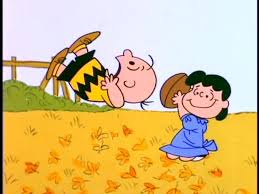
Lucy, Charlie Brown, Football Part 11: 1999 The End

1999: Close the Gate


43. October 24, 1999 
At the end of Kafka's "Before the Law" the man from the country is dying. He asks the gatekeeper why no one else has ever sought access to the law through this gate.  I picture this scene as the final panel of a football routine. The Man from the Country assumes Charlie Brown's posture. "He can no longer hold up his stiffening body," so he waves for the gatekeeper.  The gatekeeper leans over the dying man; he has to "bend way down to him."  The gatekeeper shouts his punchline, and it is worthy of Lucy. "Here no one else can gain entry, since the entrance was assigned only to you. I'm going now to close it." What the man from the country thought was an access point to the law was really a blockage. I like to think that his final, unrecorded thought is "RATS!" We are never told what the gatekeeper does after he closes the gate, but we can assume that his job is finished. With no one to seek access through this specific gate, both the gate and the gatekeeper have become redundant.

Charlie Brown and Lucy depend on one another. They, and the football, are all integral to the football routine. The final football routine strip knows this. Charles Schulz, though, resists sentimentality, nostalgia, and closure in this final football strip by interjecting Rerun, of all characters, into the routine. Rerun did not make his debut in Peanuts until March 26, 1973 (even though he was born on May 23 1972). Rerun quickly became the third wheel of the Van Pelt family. He looks like a younger version of Linus, but Lucy never establishes the same antagonistic, loving, complex relationship with Rerun that she has with Linus. Anyway, the first two panels of October 24, 1999 offer no hint that this is a football strip, let alone the last football strip. The first panel shows Rerun standing on the steps of his house call out "Lucy!" She must not here him, because in the second panel he is walking through the grass calling out "Lunch time!" In the third panel he wanders into the football routine. We see Rerun on the left; Lucy is in the center, kneeling with the football, while she makes the usual proposition to Charlie Brown, who is standing on the right side of the panel. Rerun speaks, and since his speech bubble seems to be slightly behind Lucy's, he is probably speaking after her. He says "Mom says to come in for lunch." In the next panel, he tells Lucy "She says right now!" Lucy frowns, shuts her eyes, picks up the football and says, "Oh, good grief!" We next see a close up of Charlie Brown. He says, "That's all right . . We'll do it some other time . ." Will this or will this not be a football routine strip? In the next panel, Lucy says something truly astounding. She hands the football to Rerun and says "No, Rerun can take my place . ." Rerun then tees up the football and Charlie Brown begins to walk away from it. He finds confidence in this new situation. "This time I'll kick it . . Rerun will never pull it away . . . He just wouldn't . ." As Charlie Brown begins to run toward the football he says "So here we go!" And then Schulz pulls the football away from readers. The next panel cuts to Lucy at the table, eating her lunch. Rerun approaches, holding the football in front of him. Lucy asks "Did you pull the ball away? Did he kick it? What happened?" Lucy implies that Rerun knows about the football routine, that he knows that he should have pulled the football away. Did he? Rerun gets the punchline in the final panel. He turns away from the table and says "You'll never know . . ." Lucy can only respond with "Aaugh!" The joke seems to be on her, but I hold that it really is not. Even if Rerun did not pull the football away, even if he let Charlie Brown kick it, there would be little significance to the kick. The whole point of the football routine is that it consists of Lucy, Charlie Brown, and the football. Rerun is a red herring. When Lucy is not around, Charlie Brown has kicked and punted numerous footballs. My 10-year old son Max, who fancies himself the Peanuts expert in our house, pointed me to the strip from September 12, 1956. In it, we see Schroeder teeing up a football in the first two panels, while Snoopy looks on in the background. In panel three, we see Charlie Brown following through on a kick with a solid "THUMP." Schroeder is not Lucy. Rerun is not Lucy. Charlie Brown will never kick a football held by Lucy. The gate is closed.


Wednesday, January 17, 2018

Lucy, Charlie Brown, Football: Part 10: 1995-1998


1995-1998: Thermodynamics


39. October 29, 1995
1995 starts out in traditional form. Lucy call out "Charlie Brownnn . . ." He responds "Again?" and Lucy makes the same proposition. Like he as often done, Charlie Brown exclaims about what will happen when Lucy pulls the ball away. "I fly through the air, and land on my back, and kill myself . . . That's what happens!" Lucy's rationalization in the next panel has unintended consequences. She says "You could always sue . . ." As Charlie Brown walks away from the football in the second to last panel, he says "If she pulls the ball away, I'll sue!" He has not even turned around to run toward the football yet and we only have one panel left. In the final panel, Charlie Brown runs silently toward the football. He seems to be running slowly. He does not look particularly intent. There are no lines behind him signifying speed. In fact, running close at his heels is the World Famous Attorney (Snoopy in a bowtie and bowler hat, carrying a briefcase). Charlie Brown has lawyered up! The World Famous Attorney, of course, loses all of his cases. We never see Charlie Brown attempt to kick the football in 1995. Unlike previous years, when we did not see the attempted kick but were able to hear it, this year the strip stops in the middle of Charlie Brown's run toward the ball. How will Lucy react to the Attorney's presence? Will she be sued? We will not be told. When Josef K., after his arrest,  talks to the painter who has spent much time around lawyers, K is told that three forms of acquittal are possible: "Absolute acquittal, apparent acquittal, and deferment" (182). K is quickly told that "absolute acquittal" is impossible. "Apparent acquittal" is described as a convoluted legal process that offers little chance of actual acquittal. "Deferment," then seems the best option. In a deferred judgment, the trial is kept open but it never passes its initial stages. Preliminary interviews take place, but the trial never proceeds. As the painter says, "the trial's been artificially constrained inside a tiny circle, and it has to be continuously spun round within it" (192). Josef K. chooses this option, and so does Charlie Brown. From year to year, his straight lines toward the ball become a circle. He kicks; he misses; he kicks again; he misses again. By this point readers do not even need to see the attempt to know that it is always taking place.


40. October 20, 1996

Once again, we start with the giant football. This time Lucy and Charlie Brown appear to be lying asleep on opposite sides of the football. Are they finally becoming exhausted with this routine? Do they just want to rest? Panel two shows Charlie Brown looking to the left. Hand held over his heart, he says, simply, "Me?" We can finally see that Charlie Brown is playing a role just as much as Lucy is. Of course it is you Charlie Brown. Who else could it be? Lucy offers the usual proposition and Charlie Brown responds with the same indignation. To convince Charlie Brown that things might be different this year, Lucy returns to one of Charlie Brown's old themes: symbolism. In 1982, Charlie Brown goes on and on about the symbolism of the routine. He wonders if he has "missed the symbolism." This year, Lucy returns to that theme. "Symbolism, Charlie Brown! The ball! The desire! The triumph! It's all there!" Charlie Brown of course falls for this challenge. He repeats part of what Lucy says and adds "She may be right . . " as he walks away from the football. As he runs toward the football he says "The ball? The desire! I see it!" Charlie Brown feels like he has finally found meaning in the routine at this late date. He quickly sees his error. "Aaugh!" "Wump!" He is on the ground. Lucy has not smiled during this whole routine. In 1982, her reply to Charlie Brown's wondering if he missed the symbolism of the event was a purely literal statement "You also missed the ball, Charlie Brown." It has taken fourteen years, but Lucy finally closes the hermeneutic circle around Charlie Brown's neck. "No, you missed the symbolism, Charlie Brown" First, in 1982 he missed the ball; now he misses the symbolism and the ball. He asks, dizzy and propped on his elbows, "How about the reality?" You, Lucy, and the football are the only reality.

41. September 21, 1997
There are only three football routine comics left. This one starts in the traditional way. Lucy call Charlie Brown. As he walks toward her, he asks "Why me?" He answers his own question, "Because I'm stupid, that's why!" Lucy makes the usual proposition. Charlie Brown looks especially glum, in the fourth panel, as he states what will inevitably happen. His eyes are drawn close together and his mouth is a tight frown. Lucy offers him some hope. "Not necessarily . . . people change . . Times change . . . You can feel it in the air . ." Charlie Brown is convinced. He agrees with Lucy. "I think she may be right . . . I've noticed the same feeling . . " he says, as he walks away from the football. He runs toward the football with confidence, intent to "kick that ball clear over the border!" Are times changing because the football routine is reaching its end? Has Lucy's nostalgia and depression of the last few years led her to rethink pulling the football away? Will Lucy give in to sentimentalism? Not this year. "Aaugh!" She pulls the ball away and Charlie Brown flies through the air. But Lucy has done something different! As she pulls the football away, she turns her head and shouts out "Where? Where ?!" Charlie Brown lands with a "Whump!" The final panel shows Charlie Brown sitting up, a curling line and three stars floating around his dizzy head. Does his sitting up signify that more time has passed than usual? Has he recovered enough that he no longer needs to lie down? As he sits, Lucy kneels next to him and says "Sorry Charlie Brown . . . I thought I heard someone say the millennium is coming . . ." Yes, Lucy has made a Y2K joke, and nearly three years early. She clearly had this one planned out. It is worth noting that this is one of the few times that Peanuts makes reference to a specific year, even as there is nothing specifically millennial about this particular strip.


42. November 15, 1998
This is the penultimate football routine strip. The first panel gives the the final appearance of the giant football. Charlie Brown reclines, his head resting against the bottom of the football. Lucy peers around the top of the football. Is she floating? Is she holding onto the football? All we can see is her head. In panel two, a kneeling Lucy calls out "Over here!" She makes the proposition. Charlie Brown has a new response "I can do that . . ." Lucy looks slightly surprised in the next panel where we see a close up of their faces. "You can?" she asks. "Absolutely! I have a new positive attitude!" Charle Brown answers. Does he truly believe he can kick the football? Or is he trying to outsmart Lucy? Does Charlie Brown believe that his baseball team will win a game? Does he believe that he can fly a kite and avoid he kite-eating tree? Does he believe he will get a Valentine? As Charlie Brown walks away from the football, Lucy says "I can't believe it . . You are truly amazing! You talk the talk and you walk the walk!" Charlie Brown runs silently toward the football. "Aaugh!"Lucy pulls the football away but her face shows little emotion. She is neither smiling nor frowning. She is simply doing what she has to do. In the final panel, she stands over Charlie Brown, who is propped up on his elbows, and says "But you don't kick the kick . . ." Lucy has finally stated the fundamental truth of the football routine.  Charlie Brown will never kick a football held by Lucy. His best chance was in 1979, but he missed. His missing the football is a basic physical truth, like the "Wump!" of gravity made by his falling body. This year's strip omits Charlie Brown's landing. We know it is there, though, just like we know that energy is neither created nor destroyed, only transferred from one form to another, but never from Charlie Brown's foot to the football.


Monday, January 15, 2018

Lucy, Charlie Brown, Football: Part 9: 1990-1994


1990-1994: The Return of the Giant Football


1990
There are a series of strips involving Charlie Brown, Peggy Jean, and a football, but since Lucy is not involved I will not write about them here.


35. September 9, 1991


In the first panel, the giant football is back. Charlie Brown precariously holds on to it on the left side while Lucy ascends the right side. She looks to be peering past the football's laces, looking for Charlie Brown. Charlie Brown looks like he is about to fall off. Panel two shows Lucy singing out "Charlie Brownnn!" with three "n"s, an exclamation point, and three eight notes! Lest we get distracted by her enthusiastic singing, we have to note the open book that sits on the ground next to her. Lucy clearly has a plan. She makes the usual proposition to Charlie Brown as he looks at her. The book is visible between them. Charlie Brown does not seem to see it. He tries a sarcastic response. "Congratulate me! You have just nominated me 'most stupid kid of the year" Lucy sets the trap. She holds up the book as she tees up the football. She tells Charlie Brown that she has been reading a book about "holding the ball . . ." She stands, and tells Charlie Brown that the book "tells how to hold it for the kickoff, for field goals, and for extra points . . . ." We have never been told if Lucy and Charlie Brown are pretending that they are in a real football game? Is Charlie Brown imaging the opening kickoff? Is Lucy envisioning a game-winning field goal? We have never been given a scenarios beside Charle Brown running up and kicking the ball. Charle Brown has sometimes said how far he will kick the ball, such as today when he says he is going to kick the "ball all the way to Onaha!" He seems to have given up the dream of kicking it to the moon. Before we reach this moment, we see Charlie Brown walking away from the football; we see that he has fallen for the power of the written word once again. "If someone is reading a book about something, I guess you have to trust her . . ." Has Charlie Brown not learned that this is true? Is he just convincing himself? "Aaugh!" "Wham!" The final panel returns us to a recurring tableau. Charlie Brown lies prone, with lines and asterisks over his head. He looks toward the reader. Lucy stands over him, the book in her right hand, the football in her left. She leans over and says "I wrote the book, Charlie Brown!" Lucy asserts her power. She makes a claim to be the rule-maker. Has she actually written a book that lays out the rules for the football routine? Has she written down her various methods of getting Charlie Brown to run toward the football? Has she codified her justifications and rationalizations for pulling the football away? Has she written the book on Charlie Brown? As readers do not see the pages of the book, we cannot know. Every day, Lucy writes the book.


36.  October 11, 1992


The giant football appears again. It has a tooth-bearing grin as it looks toward its left, where we see Charlie Brown's head and neck.  He glances to his right. He looks scared. In panel two, he looks toward the left. Lucy must have called him, but we do not see her call. All we get is Charlie Brown asking "Why me?" At the end of his life, the man from the country asks the gatekeeper of "Before the Law" a similar question. "How is it in these many years no one except me has requested entry?" The gatekeeper answers, "Here no one else can gain entry, since this entrance was assigned only to you." The football is only for you Charlie Brown. Is the football the law itself? Lucy makes her proposition. In a panel that is about a quarter the size of a usual panel, Charlie Brown says "She sounds sincere." As he walks away from the football in the next panel, he continues this thought, "If a person sound sincere, then they must be sincere . . . ." Has Charlie Brown been talking to Linus too much? Lucy has played the sincerity card before. On September 1, 1963, she offers Charlie Brown a handshake and then says "Let's shake on it . . . This proves my sincerity . . ." The same thing that happened in 1963 happens again in 1992. Lucy pulls away the football, but she has only smiled once in the last four years. The smiling football in the opening panel seems even more ominous. Who is enjoying the football routine? Lucy clearly enjoys her punchlines, but these are becoming less frequent. This year, we get the requisite "Wump" followed by three more panels. Lucy is gone, though. Inexplicably, Sally walks in from the left, and asks Charlie Brown, who is now propped up on his elbows with his head still spinning, "You're not in love with Lucy, are you, big brother?" Charlie Brown answers "I should hope not." Sally seems to have been watching. She seems to know about the football routine. She has appeared once before, as one of the figures holding a football in the Kafka-esque final panel of 1983. Has Sally been watching, out of the frame, this whole time? We will see her again in two years, and the answer seems to be yes. Back in 1992, she tells her brother "I've discovered that love makes us do strange things . ." Sally seems to be looking for a parallel in her relationship with Linus in Charlie Brown's relationship with Lucy. Charlie Brown simply replies "So does stupidity" He is sitting up; there are lines around his head. He looks dizzy. The first panel of the smiling football looks more and more ominous. And why has Lucy walked off without offering a final word. Things are getting weird.


37. October 3, 1993

Once again we start with the giant football. Lucy is atop it, her arms stretched over the top of the ball. She smiles, as if she has climbed a mountain. While the football dwarves her, she seems to control it. In panel two, she points the football to the right as she calls out "Over here!" Charlie Brown appears, and listens with his hand to his chin as Lucy prefaces her normal proposition by saying "This is a brand new ball, Charlie Brown!" Like usual, Charlie Brown falls for any line Lucy offers. As he walks away he says "A brand new ball! Wow!" As he runs toward the football he says "This is a real treat!" Lucy pulls the football away and watches Charlie Brown land with a hard "Wump" that causes his whole body to vibrate. Lucy looks completely indifferent to Charlie Brown's pain. In the final panel, Charlie Brown lies prone and looks out toward the reader. Lucy continues to kneel. She looks not at Charlie Brown but at the football. "It suddenly occurred to me that if I let you kick it, it wouldn't be new anymore." Neither of them should be surprised. There should be no sudden occurrence. We are back on November 15, 1952 and Lucy's very first reason for pulling the football away. When toddler Lucy pulled that football away from Charlie Brown she meant it when she said she did not want her new football to get dirty. Whether she remembers 1952 or not, 1993 gives us a different Lucy and a different Charlie Brown. 1952 was two kids playing. 1993 is a choreographed scene, burdened by the past. Time is running out; the power of routine holds on.


38. October 16, 1994


1994 starts with Lucy breaking the routine, seemingly out of impatience. Instead of waiting outside with the football and calling to Charlie Brown, Lucy, football under her arm, rings his doorbell. Sally answers the door. Lucy holds out the football as Sally says "What's up?" Lucy offers her proposition to Sally to give to Charlie Brown. "Tell you brother to come out . . . Tell him I'll hold the ball, and he can come running up and kick it . ." Sally looks perplexed, but she does what Lucy asks. Sally finds Charlie Brown sitting in his bean bag chair. He looks back over his shoulder as Sally says "She's here again . . Why does she think you're dumb enough to be fooled again?" Charlie Brown says nothing. In the next panel, we see Lucy walking on the lawn, followed by Charlie Brown a few steps behind on the porch. Sally, a few steps behind him, sticks her head out the door and says "You don't really believe my brother is that naive, do you? Neither Lucy nor Charlie Brown say anything. They do not even turn back to look. Sally steps onto the porch and the point of view remains with her. She call out "How often do you think you can fool someone with the same trick?!" In the next panel Sally puts her hands to her mouth as we hear an "Aaugh!" with the speech bubble coming from the left of the panel. The next panel gives us a "Wump!" as Sally jumps into the air. We have reached the point where an exclamation and the sound of a body hitting the ground tell us all we need to know. Next, we see a dizzy Charlie Brown walk past Sally, a curling line and an asterisk over his head. He goes inside, and Sally offers the punchline to no one "Pretty often, huh?" What was Charlie Brown doing when Lucy rang the doorbell. Often, one sitting in a beanbag chair in Peanuts is watching tv. The right side of the panel is cut off, though, so we cannot know what Charlie Brown is doing in the beanbag chair. The way he walks silently past his sister strongly implies that he is returning to the beanbag chair and continuing to do whatever he had been doing before the football routine interrupted. He probably has a headache, but he seems otherwise unaffected by what has just happened. Likewise, we neither see nor hear Lucy in the final five panels. We do not know how she reacts when she pulls away the football. She has nothing to say. Routine goes on for the sake of routine.

But there is something strange about Sally appearing in two of the first four 1990s strips. In the series of strips from 1979, Linus offers commentary about the football routine. And, as noted above, Sally, Woodstock, Snoopy, Peppermint Patty, and Marcie all hold footballs in 1983. 1992 and 1994, though, provide the most commentary by another character about the football routine. Sally seems somewhat indignant, as she asks the questions that Charlie Brown has stopped asking.

Thursday, January 4, 2018

Lucy, Charlie Brown, and 43 Footballs Part 7: 1980-1984


1980-1984: Before the Football Kneels Lucy


26. November 16, 1980

Last year's promise has been forgotten (or ignored), kind of.  Lucy does not offer her proposal to Charlie Brown in 1980 (unlike almost every year save 1974, and some of the 1950s strips), and Charlie Brown is silent through most of this strip. The "football" only gets mentioned in the final panel. Instead, Lucy returns to scripture. The first panel shows us Lucy looking at the football, which she has ready for Charlie Brown to kick. She says "Ecclesiastes . . Third chapter . ." Lucy is alone in this panel. Is she talking to the football? to herself? to readers? In the second panel, Lucy is holding the football when Charlie Brown walks in. Lucy has not called him this year; she does not sing out his name to get his attention. When Charlie Brown appears, Lucy simply says "Ah! Just the person I wanted to see." Charlie Brown has no response. Lucy begins her recitation of Ecclesiastes 3 in the next panel, and she directly addresses it to Charlie Brown. "'To every thing there is a season.' Charlie Brown . . ." He looks at her but does not respond. Lucy continues with the verse as Charlie Brown turns and walks away from the football. "A time to be born, and a time to die." Lucy continues with one finger of her right hand on the football, one finger of her left hand pointing upward; her eyes are closed as she recites. The view draws back in the next panel, as Charlie Brown stops and Lucy continues with "A time to weep and a time to laugh . ." This view has rarely been presented. Usually, when Charlie Brown turns toward the football, we can not see how close or far he is from it. Usually, we only see this distance closing as Charlie Brown runs toward the football. But here, in the panel, the distance does not look all that great; Charlie Brown is at most ten steps from the football. He is still silent. As he runs up, he looks determined but he does exult; he does not claim that he is about to kick the ball to the moon, or out of the universe. It is almost as if he does not want to interrupt Lucy's recitation, which continues "A time of war, and a time of peace" Charlie Brown's first, and only, word in this strip, is his involuntary "Aaugh!" as he flies through the air after missing the football. "Wham!" Lucy is done reciting, but she adds her own line in the final panel, as she looks down on a prone, frowning Charlie Brown, who looks out at us. "And a time to pull away the football" The time to pull away the football, of course, is in the moment when Charlie Brown has committed to kicking it, the moment when he cannot stop, but also the moment when he will miss the ball. If Lucy pulls the ball away too soon, Charlie Brown will presumably stop. If Lucy waits too long, Charlie Brown will presumably kick the football (or her hand, as we saw last year). Lucy is precise in her timing.

But what about the broader sense of time she appeals to in invoking Ecclesiastes 3, when she says "'To everything there is a season?'" Why does she directly address these lines to Charlie Brown? She must be referring to the recurring time of the football routine, and not just the moment when she pulls the football away. Over the more than forty years of this routine, the majority of the football strips--23-- happen in October. 12 happen in September; a mere one happens in December (and that was December 16, 1956, only the second appearance of the football routine, and thus, its first recurrence); only one happens in August (August 2, 1979, when Charlie Brown gets out of the hospital); the other five occurrences happen in November, like 1980's. In fact, 1980 is the third latest in the year the football routine happens; only November 29, 1981, and the aforementioned December 16, 1956 are later. Why did the time for the football routine happen so late in 1980? Why does it happen even later in 1981? Only Lucy knows and she is not telling us. Instead, she references to Old Testament book that reminds us "One generation passes away, and another generation comes; / But the Earth abides forever. / The sun also rises, and the sun goes down / And hastens to the place it arose." No matter the time scale--be it the generational one of humans, the geological one of the Earth, or the daily one of the Earth turning--nothing will change. The football routine has already happened, it is happening, and it will happen. "That which has been is what will be / That which is done is what will be done, / And there is nothing new under the sun." Lucy's timing will always be perfect. She is the true biblical scholar of Peanuts.

But Lucy and Charlie Brown are in this together. Maybe Charlie Brown is the one who has perfect timing. Ecclesiastes 10 tells us, "He who digs a pit will fall into it, / and whoever breaks through a wall will be bitten by a serpent. He who quarries stones may be hurt by them, / And he who splits wood may be endangered by it." She who holds a football will get kicked in the hand (see 1979). He who tries to kick a football will try again (remember that this whole thing was Charlie Brown's idea in 1952).


27. November 29, 1981

The time of the football routine in 1981 occurs exceptionally late in the year, November 29. Has Lucy contemplated giving up? Have 1979 and 1980 convinced her that the "time to pull away the football" has passed? Lucy seems less invested in the routine this year. In the first panel, she no longer sings out Charlie Brown's name; she looks toward him and calls out, as she kneels and holds the football, "Over here! I'm over here!" Like last year, she cannot quite bring herself to make the proposal. Instead, once the football is ready, she just looks at Charlie Brown with a smile. A smile is all he needs? Unlike his silent acquiescence of last year, Charlie Brown resists the impulse to try to kick the football--at least in his words. He says all the right words of resistance. "Does she really think I'm such a fool?" "Am I dumb enough?"  He repeats the phrase "Not again!" four times! But his body betrays him. He walks away from the football like he usually does. But the turn back toward the football he makes in panel six is masterfully drawn. The still image, by showing his feet (and his elbows) pointed in opposite directions, implies an unwilled movement toward the football. The two lines that follow the curve of his left arm show the change in direction that his body has undertaken, seemingly on its own. The routine has become a matter of muscle memory. Whatever he says, Charlie Brown cannot and will not stop. As he runs toward the football he asks "Is it really happening again?"  This question reminds me of a scene from season 2, episode 7 of Twin Peaks, which aired nine years after this strip, on November 11, 1990. The character then known as The Giant, appears in a vision to Agent Dale Cooper, and says twice, "It is happening again." Time loops through weird repetitions in Twin Peaks, especially given Cooper's question, "What year is it?" in the final episode of Twin Peaks: the Return, in 2017. Time loops through weird repetitions in Peanuts, too. After he misses the football, "Wump!"Lucy leans over him and says "Again Charlie Brown . . . . and again, and again and again." Charlie Brown looks toward us with a frown. This strip might be the eeriest of all the football routine strips. Look again at panel six. Charlie Brown cannot control his own body. What possesses him?


28. October 10, 1982

1982 returns immediately to the "not again" phrasing of last year; this year, Charlie Brown asks it as a question in the first panel, "Not again?" as he stands in the grass and looks toward the left, presumably at Lucy. He walks in the direction he is looking in panel two as he says "I can't believe it." We do not even see Lucy in the first two panels. When we finally do see her in panel three, she does not even have to speak. She looks at the football she is holding as Charlie Brown speaks. She remains silent, turning her head to watch Charlie Brown as he walks away from the football. He wonders about the symbolism of the football routine. He says "there has to be something deeply symbolic in that." He cannot figure out what it might mean, though. Even as he has "tried to study it from every angle. . . ." he says, as he runs toward the ball, "somehow, though, I've missed the symbolism . . ." Why has Charlie Brown suddenly become so interested in "symbolism?" Is he trying to find a previously hidden meaning to this act? Does he think it reveals something about his character? About his life? Perhaps. But why now, in the 28th occurrence of the routine?

In Franz Kafka's short story "Before the Law," a man from the country seeks access to the law. He meets a gatekeeper at the door that he hopes will allow him to "entry into the law." But the gatekeeper  tells the man that he cannot be given access to the law "at them moment." The man asks if he we be allowed to enter later, and the gatekeeper says "It is possible . . . but not now." The man continues to wait and to try to gain access any way he can. "He makes many attempts to be let in" but never is. In one way, Charlie Brown is the man from the country and Lucy is the gatekeeper. The football is the door and kicking the football is the entry into the law. This reading, though, only makes sense when looking at a specific year's comic. In any given year, Lucy controls and denies access; Charlie Brown tries to gain access but fails again and again. But the parallel between "Before the Law" and the football routine points to a more interesting connection in a larger context. "Before the Law" appears in Chapter Nine of Kafka's The Trial, where a priest tells Josef K. "a story" about the man from the country and the gatekeeper. After he tells the story, Josef K. and the priest discuss the story's meaning. From this discussion, it seems clear to me that Lucy is the priest and Charlie Brown is Josef K. The football routine, played out over nearly fifty years of Peanuts, is both the story and the subsequent discussion of it. The priest tells Josef K. that "it talks about self-deceit in the opening paragraphs to the law." Likewise, Charlie Brown tells himself, in 1982, that he's missed something "symbolic" about his exchange with Lucy. In The Trial, the priest and Josef K. discuss many interpretations of the story, so many, that the priest eventually tells Josef K. that he does not believe any one interpretation of the story that the "commentators" have put forth. He tells K. "Don't get me wrong . . . I'm just putting out the various opinions about it. You shouldn't pay too much attention to people's opinions." That last sentence sounds like something Lucy might say as she leans over Charlie Brown in the final panel of a football routine strip. Instead, this year she says, in response both to Charlie Brown's claim that "I've missed the symbolism" and his attempt to kick the football ("Wump!"), "You also missed the ball, Charlie Brown" The priest tells Josef K that "the text cannot be altered, and the various opinions are often no more than an expression of despair over it." That expression of despair is Charlie Brown's repeated "Augh!" every year. Later the priest tells Josef K. that "you don't need to accept everything as true, you only have to accept it as necessary." Lucy has been telling Charlie Brown the same thing every year, when she lies to him and when she avoids lying through a justification, often centered on a document. K's reply to the priest is embodied in Charlie Brown's facial expression in the last panel, or more precisely, in every one of Charlie Brown's facial expressions over the years in the last panel, as he looks toward his readers. "Depressing view . . . the lie made into the rule of the world." He knows that the lie is a lie; he knows that Lucy will pull away the football, but still he "stud[ies] it from every angle," and still he tries to kick it. Before the football kneels Lucy.


29. October 16, 1983

In he opening panel of October 16, 1983, Charlie Brown stands in the same posture he did in 1982, hand at his side as he faces toward the left, presumably looking at Lucy. There is a tree in the background this year, and Charlie Brown's words are different, too. He says "She's got to be kidding!"  Just like last year, he walks toward Lucy and the football, and says "She must think I'm really dumb . . .," a variation on a theme he has stated many times before. Lucy greets him with a smile and says "Here we go, Charlie Brown . . ." before she makes the same proposition she has made before. In response, Charlie Brown spreads his arms wide and begins to pontificate. In the next panel, he faces Lucy, and with his arms gesturing before him, he says, "Well, I have news for you . . . Never again! Forget it!" Lucy frowns ands begins to panic. She picks up the football and exclaims "Wait!" Charlie Brown walks away. He does not turn back; he controls his body. He turns his head, but only his head. As he continues walking, he says, "I'm just glad you're the only person in the world who thinks I'm dumb enough to fall for that trick again . . . " CHARLIE BROWN DOES NOT TURN BACK! HE DOES NOT RUN UP! HE DOES NOT TRY TO KICK THE FOOTBALL!! FOR THE FIRST TIME SINCE 1973 (and for one of the few times ever) THERE IS NO "AUGH!" THERE IS NO "WUMP!" OR "WHAM!" This is the beginning of the end of the football strip as it has existed since the 1950s. In 1984, we will not see Charlie Brown try to kick the football, and the football strip takes place in a single weekday four panel strip. There is NO FOOTBALL ROUTINE in 1985. Most of the rest of the strips in the 1980s will be reflective on the football routine itself, even nostalgic. While the 1990s strips will return to earlier themes and ideas, there is no football routine with Lucy in 1990, and in three years of the 90s there is either no attempt to kick the football, or the attempt takes place off-stage. The last football strip will run in 1999, but 1983 is the beginning of the end. But I'm getting too far ahead of myself.

Something else happens in 1983. After he turns back and tells Lucy that he is glad she's the only person "in the world" who thinks he would fall for "that trick again, " Charlie Brown walks into the last panel and into perhaps the most Kafkaesque panel that Charles Schulz ever drew. In "Before the Law," the gatekeeper tells the man from the country that the gatekeeper is only one of many gatekeepers standing between the law and the man from the country. The gatekeeper says "And I am only the most lowly gatekeeper. But from room to room stand gatekeepers, each more powerful than the other. I can't endure ever one glimpse of the third." The man from the country cannot simply sneak past or walk away from the gatekeeper. Charlie Brown looks shocked as he realizes that he cannot just walk away from Lucy and the football. Arrayed before him in the final panel are five kneeling, smiling figures looking at him--Woodstock, Snoopy, Sally, Peppermint Patty, and Marcie. Each holds a football ready to be kicked. Woodstock's football is tiny.


30. October 13, 1984

October 13, 1984 was a Saturday. Peppermint Patty lies on a beanbag chair and speaks on the phone. "Hi, Chuck," she starts. She complains about how Marcie is "driving me crazy" because "she'll never be a football player." In panel two, Patty is drawn closer up, like a camera is zooming in on her. She says "Some people just never learn, do they Chuck?"  Where is this going? How is this a football routine strip? Except for the special case of 1979, every football routine strip has been a Sunday strip, a longer stand alone story that takes place mostly outside the plot of the daily strips. The Sunday football routine strips refer to each other more than they do to the strips that surround them on the calendar. Nonetheless, and to continue the filmic metaphor of the close up, there is a jump cut between panels two and three. We no longer see Patty talking, but we do not see the expected cut to Charlie Brown responding over the phone from his house. Instead, we see Lucy. She is kneeling and holding a football, but she is right outside of Charlie Brown's house. She calls out, with a pair of eighth notes to show that she is singing out his name "Charlie Brown . . . C'mon outside . . . I'll hold the ball, and you kick it . . ." Suddenly we are in the midst of the football routine. The final panel of the comic takes us to the expected scene of Charlie Brown speaking into his phone. He says "No, we don't" He does not say, "No, they don't." He says "we." He knows he is one of the people who "just never learn." Charlie Brown is standing near a window. His eyes are looking toward the window and away from his phone conversation. He has heard Lucy's call, which, given the time frame of the comic and the way it cuts from place to place, she must have been making either as Patty was talking or in the moment after she finished talking and before Charlie Brown responded. The comic ends. If readers were expecting a Sunday football routine strip in 1984, they were disappointed. If they were expecting the Monday, October 15 strip to pick up where the Saturday, October 13 strip left off, they were disappointed. On October 15 we are with Spike in the desert. The next football routine strip is two years away!


Monday, November 20, 2017

Lucy, Charlie Brown, and 43 Footballs Part 3: 1965-1969


1965-1969: The Girl without Kaleidoscope Eyes


11. October 17, 1965

Lucy has turned this ritual into a yearly holiday as she calls out "It's that time of year again!" She sings with happiness in the first panel with an extended end note on her call to "Charlie Brown-n-n-!" She sings in the second panel as she sets up the football and awaits the answer to her call. "Tum Te Dum Te Ta De Dum" with a pair of linked eighth notes. When Charlie Brown appears and simply says "Okay!" to Lucy's entreaty, we can assume that this year he has a plan. And he does. He walks home and sits in a big comfy chair to make Lucy wait. "If I have to, I'll  sit here in the house until midnight and make her wait!" Lucy has the football set in the next panel, but she knows that something is wrong. Her mouth is a small straight line, and her eyes seem slightly unfocused as she looks silently at the football. Charlie Brown looks out his window, into the darkness, both hands pressed against the window. He is Franz Kafka's man looking out a window in hope of some connection. "Whoever leads a solitary life and yet now and then wants to attach himself somewhere, whoever, according to changes in the time of day, the weather, the state of his business, and the like, suddenly wishes to see any arm at all to which he might cling - he will not be able to manage for long without a window looking on to the street." He sees just what he hopes to see. The full moon has risen; under its light, Lucy still holds the football ready to be kicked, but her eyes are shut and there is a "Z" over her head. She is asleep. Charlie Brown sneaks out, checks that she is indeed sleeping and walks away gingerly to gain the space necessary for his run. As he runs he says "She really slipped up this time!" Lucy simultaneously opens her eyes, smiles, and pulls the football away. "WHAM!" In the final panel, she stands over Charlie Brown, who we can see from the zig zag of his shirt up to his head. Like in 1961, his head is turned outward; he frowns toward the reader, his plan ruined. Lucy looks down and says "We fanatics are light sleepers, Charlie Brown!" Was she truly asleep? Would Charlie Brown's plan have worked if he just been a little quieter in his run up to the football? Unlikely. But who is the fanatic? Fanaticism runs in the van Pelt family; think of all the Halloweens Linus has spent in a pumpkin patch awaiting the arrival of the great pumpkin. Think, too, though, of the number of times he has fallen asleep while waiting. Maybe fanatics are not light sleepers after all. One should also consider why Lucy defines herself as a "fanatic." The simplest answer might be that she feels a compulsion to celebrate this football ritual every year. Of course, Charlie Brown, in his desire to kick the football is also a fanatic. Is the whole football routine a secret ritual between two fanatics? Holidays have been established on less. As I write this, it is 27 days until Beethoven's birthday.


12. September 25, 1966
This year starts of in the realm of the mundane.  For the first time, Charlie Brown stands alone in the first panel. He utters a succinct "Oh, Brother!" The second panel changes the perspective so we can see that he has been looking at Lucy, who has the football ready. She simply asks "Well?" We can not see Charlie Brown's reaction. There is no argument, no attempt to convince. They both know what is about to happen. Lucy finally asks the question, "How about it, Charlie Brown?," with the now familiar grin that accompanies it. He crosses his arm in aggravation and Lucy resorts to a variation of her ploy from 1960. She tells Charlie Brown that only"an involuntary muscle spasm" will make her pull the ball away this year. She continues "the odds must be astronomical against such an involuntary muscle spasm occurring at the very moment you try to kick the ball. . ." Charlie Brown agrees and walks back and begins his run. "WUMP!"In the last panel Charlie Brown lies on his back, his head turned facing the reader, a pencil swirl of disorientation floating just above his ear. Lucy sits, her arm resting on the football, and produces a document from which she reads that the odds of an "involuntary muscle spasm occurring at that precise moment were ten billion to one!" Let us put aside the question of how Lucy was able to look up this fact and produce a document in the brief moment when Charlie Brown flies through the air and lands with a wump. More importantly, in the third to last panel, the one where Lucy pulls the football away, something happens for the first time in 1966. Lucy is not smiling. She looks perplexed; her mouth is a small line and her eyes look at Charlie Brown in the air with surprise. Every other year, Lucy has looked gleeful, with a smile, usually an open-mouthed grin on her face as she pulls the football away. She has only looked perplexed twice before, both in 1952 when she does not intentionally pull the football away. Even then, though, she grins at the result of Charlie Brown flat on his back. Here, her perplexed look continues as she reads aloud from her research in the final panel. Either Lucy is a very good actor, or she actually had an involuntary muscle spasm at the exact moment Charlie Brown tried to kick the football. By this point, though, we know that if Charlie Brown's and Lucy's actions are not voluntary, they are at least compulsory.


13. October 1, 1967

The summer of love has just ended and Lucy looks ecstatic as she holds the football with two hands and with eyes closed sings out "Charlie Brownnnnnn." She continues to smile as Charlie Brown heeds her call and responds "Oh, No . . . Not Again!? But Lucy tells Charlie Brown "I have a surprise for you this year." Charlie Brown holds his hand to his chin and smiles. He takes her promise of a "surprise" to mean "she isn't going to pull it away." He smiles in profile as he leans forward with determination as he walks away from the ball. He runs toward it, teeth bared in intensity while Lucy sticks her tongue out of the corner of her mouth, concentrating as she adjusts the ball. The Beatles released the song "Lucy in the Sky with Diamonds" in 1967. John Lennon claims that the song's title has nothing to do with LSD. Instead, he found his inspiration in a drawing done by his three year-old son Julian. "My son came home with a drawing and showed me this strange looking woman flying around," Lennon said. When asked what the drawing was, Julian told him "It's Lucy in the sky with diamonds." Paul McCartney has compared Julian's drawing to a Chagall painting "with people floating around . . . I think it's something to do with kid's not realizing that people have to be put on the ground." Oh. Wait. Lucy is a child but she is not a flower child. She knows that people have to be put on the ground. Her surprise is of a different sort. The last panel shows us a television monitor connected to a camera. Lucy says, "And now for the surprise . . . Would you like to see how that looked on instant replay?" Charlie Brown lies on the ground like last year, a pencil swirl above his head. Even with the tools of mechanical reproduction at hand, neither Lucy nor Charlie Brown will be satisfied with the repetition of instant replay. They will come back, again and again, to produce both repetition and difference.


14. September 29. 1968

Once again cradling the football, Lucy gleefully sings out "Charlie Brownnnn" with three eighth notes in her speech bubble. We actually see Charlie Brown walking toward her this year in the second panel, even as he says "She must think I'm the most stupid person alive." After the usual exchange, Lucy tries a new appeal. "Don't I have an innocent look about me?" She leans on the football, looks up at Charlie Brown with a smile and continues "Look at the innocence in my eyes . . ." Charlie Brown is convinced. "She's right . . . If a girl has innocent-looking eyes you simply have to trust her . . ." But he does not look convinced. He says these lines with a neutral expression as he walks away from the football, standing straight and neither smiling nor frowning." He begins his run toward the ball with a determined look but with nowhere near the intensity of 1967. "Wham!" For the first time in a few years, Lucy leans over a prone Charlie Brown in the last panel. She tells him that what he has "learned here today . . . will be of immeasurable value to you for many years to come." Charlie Brown responds with a "Sigh!" He knows the game is not over. There are no high-growing flowers or rocking horse people here. It is a mistake to try to ground the kicking of the football in a world of love and innocence. Or is it?


15. September 28, 1969

In the most despairing and unrealistic opening panel yet, Charlie Brown stands in the shadow of a giant football at least three times his height. Panel two brings us back to the real world. Lucy holds a regular football and with a small grin simply calls out "Charlie Brown?"She doesn't sing or string out her pronunciation of his name. She makes the same proposition; Charlie Brown rejects her with the wave of a hand as he turns away. And then things really turn. Lucy turns her head toward the sky; her mouth becomes a gigantic black shape as she cries out "WAAH! YOU DON'T TRUST ME!"Charlie Brown stops abruptly and turns his head, seemingly in shock at Lucy's emotional reaction to his words. He kneels down next to here, arms out, and says "I'm sorry . . . Please don't cry." He begins to walk away, and stunningly, he says Lucy's words for her, with only a change in pronouns. "You hold the ball, and I'll come running up and kick it." In response, Lucy can only "Snif." The panel of Charlie Brown running toward the football is drawn smaller, as if from a further distance than usual. He says nothing as he runs. Lucy's smile returns as she pulls the football away. "WUMP!" Another pencil swirl floats above Charlie Brown's head, this time punctuated with a single star, he looks outward, confused, as Lucy leans in only slightly and says "Never listen to a woman's tears, Charlie Brown!" She offers him a variation on last year's point. The world is changing. Women and girls are neither innocent nor weak. The 1960s are over. The attempt to kick the football is not. And to jump ahead to the 1980s and 2010s for a moment, these 1960s strips show why putting Smith's lyrics into the voices of Peanuts characters is neither clever nor telling. I love the Smiths, but Charles Schulz had mastered maudlin irony long before Morrissey had ever found a job.


A Report From Nancy Fest

      A Report From Nancy Fest   We (my son and I) arrived at Nancy Fest at around 7:30 on Friday, May 24 so we missed most of the welcome t...